The iPhone Cost $499 in 2007. What Does That Price Mean in 2026?

Published by
Gadriel Borbor Gargard3 min read
The original iPhone began at $499 in 2007. Inflation, storage, carrier subsidies and major hardware changes make today's flagship prices a more complicated comparison.
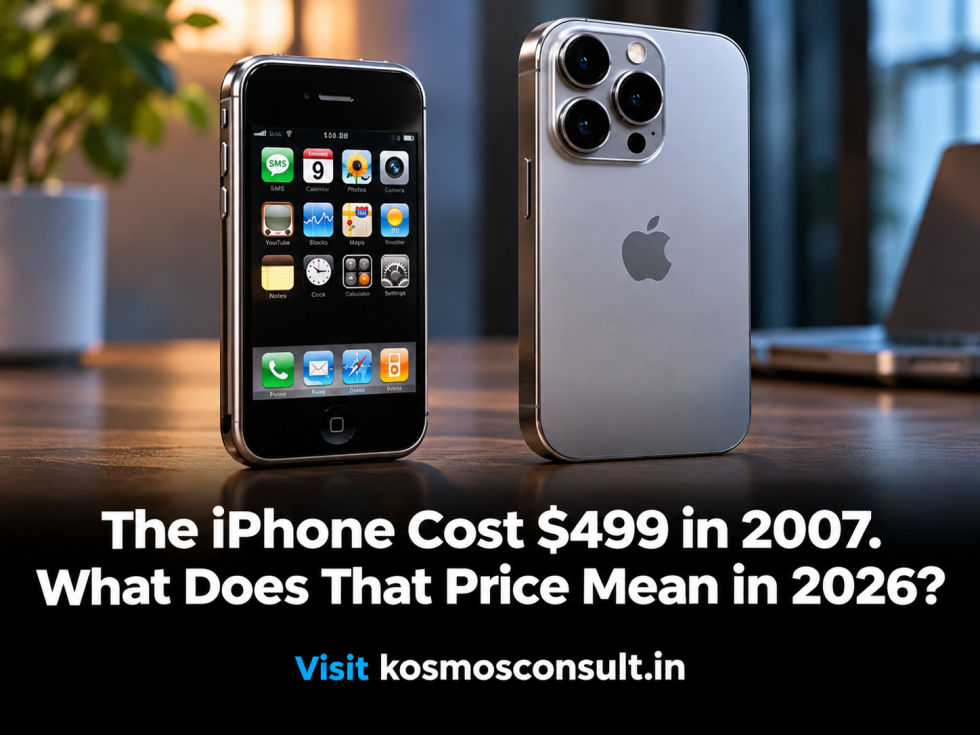
Editorial comparison of the original 2007 iPhone and a modern flagship iPhone, without fabricated product details.
On this page
When Apple introduced the first iPhone in January 2007, the starting price was $499 for a 4GB model. The 8GB version cost $599. Nearly two decades later, flagship iPhones occupy a very different price bracket, but comparing those numbers without context misses the real story.
The iPhone did not simply become more expensive. The product itself changed, storage expanded, hardware became more sophisticated, and Apple's pricing strategy moved away from the early carrier-subsidised market.
What $499 Bought in 2007
The original iPhone arrived with a 3.5-inch multi-touch display, a 2-megapixel camera, EDGE mobile connectivity, Wi-Fi and Bluetooth. It had no App Store at launch, no 3G connectivity and no front-facing camera.
Apple's original announcement confirms the $499 price for 4GB and $599 for 8GB. Both prices were tied to the early US carrier arrangement. In September 2007, Apple cut the 8GB model's price to $399, a decision that frustrated early buyers.
Inflation Changes the Comparison
Using a US inflation estimate, $499 in 2007 has purchasing power of approximately $811 in 2026. That is a more useful starting point than comparing the raw price alone.
But inflation is only one part of the calculation. The original 4GB model had a fraction of the storage available in modern flagship phones. Current models also include high-resolution multi-camera systems, advanced processors, OLED displays, satellite features in supported regions, and much more capable wireless connectivity.
A modern flagship is not the same product with a higher price tag. It is a substantially different device.
The Flagship Price Has Moved Into Another Category
Current 2026 price listings show the iPhone 18 Pro Max starting around $1,299 in the United States, with higher-storage configurations costing considerably more. The iPhone Duo range is listed at a higher premium still. These are nominal prices, before local taxes and regional pricing differences.
The comparison is revealing: the $499 starting point has not merely followed inflation. Apple's premium models now occupy a much higher price tier, while the entry-level and flagship ends of the product line serve different buyers.
So, Is the iPhone Genuinely More Expensive?
The answer depends on which model we compare. The cheapest iPhone available in a given year is not a fair equivalent to the most expensive flagship.
A serious comparison should account for inflation, storage, product tier, carrier subsidies, and the features included. Once those are considered, the question becomes more interesting than whether Apple has raised prices.
It becomes a question about how much value consumers are willing to pay for a phone that has grown into a pocket-sized computing platform.
Reference: https://www.apple.com/newsroom/2007/01/09Apple-Reinvents-the-Phone-with-iPhone/ iPhone price history: https://www.iphonenation.com/history/