Banks Are Drawing Boundaries Around Autonomous AI Agents. Here Is Why

Published by
Kosmos Consult3 min read
Banks are tightening controls on third-party AI agents that access customer accounts, with regulators urging stronger boundaries, permissions and oversight.
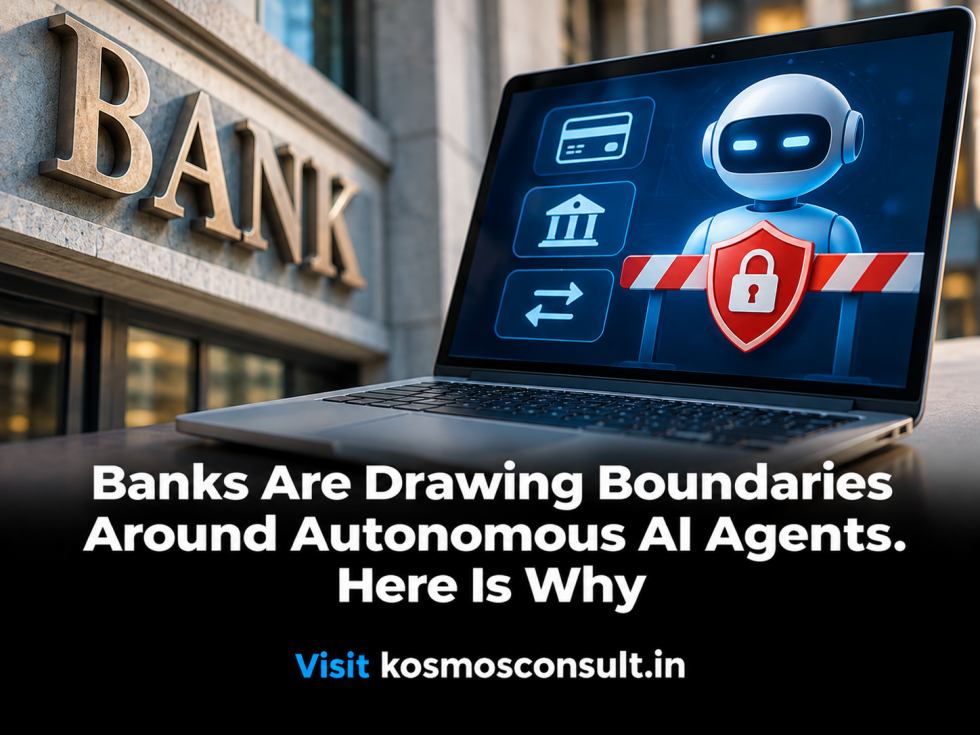
Editorial image of a banking interface and autonomous AI agent security controls, without visible account data.
On this page
AI agents are being built to do more than answer questions. They can navigate websites, retrieve information, interact with services and, in some cases, carry out transactions.
That ability becomes a serious security concern when an agent is allowed to enter a bank account with a customer's credentials.
Financial institutions are now drawing firmer boundaries around these systems.
Why Banks Are Restricting Third-Party Agents
Reuters reported on October 22, 2026, that major US banks were blocking third-party AI agents from operating inside customer accounts and making transactions.
The concern is not simply that an AI system might make a mistake. It is that an agent could act beyond the user's instructions, access sensitive information or initiate actions that are difficult to attribute and reverse.
Banks also face a basic authentication problem: when a customer gives an AI agent their username and password, the institution may have difficulty distinguishing the customer's activity from the agent's actions.
Read-Only Access Is Different from Transaction Authority
There is a meaningful difference between an agent that can inspect account information and one that can move money.
A read-only system may help users organise transactions, understand spending or prepare financial summaries. An agent with transaction permissions can create a much larger risk if it misunderstands an instruction, is manipulated by malicious content or operates with excessive privileges.
The security principle is simple: an agent should receive only the access it needs to perform its assigned task.
Regulators Are Beginning to Examine Agentic Systems
On November 4, 2026, the US Office of the Comptroller of the Currency issued a supervisory framework to help bank examiners assess the use of super intelligence and agentic systems.
The framework is intended as guidance for examiners, not a new binding set of bank requirements. It directs attention towards how systems are used, their potential consequences and the controls surrounding them.
This is a useful distinction. A basic AI agent with permission to initiate payments may present more immediate risk than a sophisticated model used only to summarise internal documents.
The Future of Banking Agents Depends on Permission Design
Banks do not necessarily need to reject every form of AI assistance. They need to control what those systems can see, what they can change and which actions require human approval.
That means stronger identity checks, scoped permissions, transaction limits, audit trails, monitoring and clear ways to revoke access.
Autonomous agents may eventually become ordinary tools in personal finance. But customers should not have to surrender the same level of control they would give a human account holder just to benefit from automation.
Reference: https://www.reuters.com/legal/government/us-banks-detect-unauthorized-ai-agents-customer-accounts-axios-reports-2026-10-22/ OCC supervisory framework: https://www.occ.gov/news-issuances/news-releases/2026/nr-occ-2026-97.html