AlphaGenome 2 Brings Single-Cell Biology Into Genetic Research

Published by
Kosmos Consult3 min read
Google DeepMind’s AlphaGenome 2 can predict how genetic variants affect specific human cell types. Trained on more than 107 million cell profiles, the model gives researchers a more detailed way to study gene regulation and disease biology.
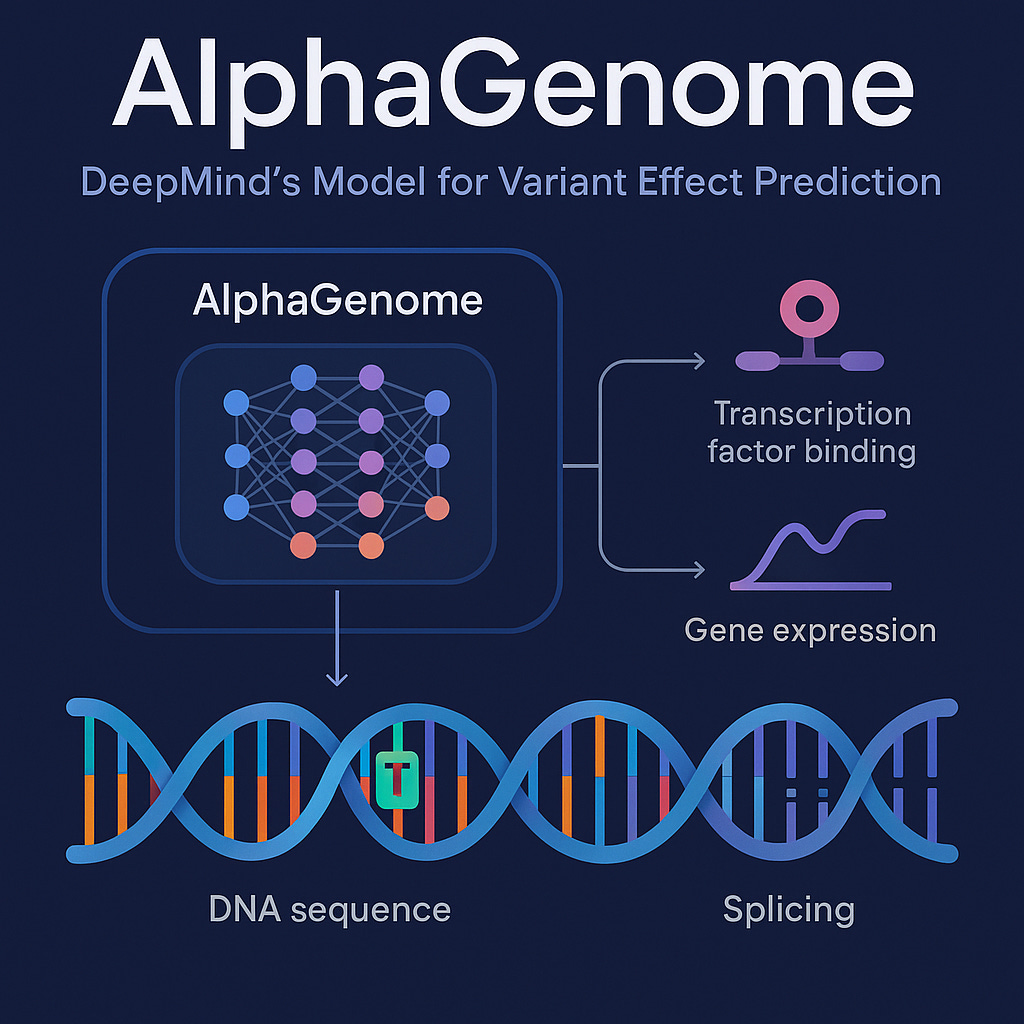
Illustration of the AlphaGenome model architecture, representing the DNA sequence analysis behind Google DeepMind’s newer model.
On this page
A more detailed view of how DNA behaves in different cells
The same DNA blueprint exists in nearly every cell in the human body. Yet a heart cell, a liver cell and an immune cell do not behave alike. Each uses a different set of genes, and the way those genes switch on or off helps determine what a cell does.
Google DeepMind says its new model, AlphaGenome 2, is designed to help researchers study those differences. Announced on November 11, 2026, the model predicts how DNA sequences and genetic variations affect specific human cell types.
That matters because a genetic variant may have little effect in one cell type but a meaningful effect in another. Looking only at broad tissue averages can hide those differences.
What the model adds
DeepMind reports that AlphaGenome 2 was trained on more than 107 million individual cell profiles across 68 tissues. The model identifies nearly twice as many variants that alter gene expression in cells compared with its predecessor.
It also moves beyond broad tissue-level predictions. Researchers can select a cell type from a reference catalogue or use the model’s cell encoder to work with data from their own single-cell experiments.
The model predicts several features of DNA activity, including gene expression, histone modifications and chromatin accessibility. It also adds DNA methylation, another layer of gene regulation that researchers use to understand how cells control gene activity.
Why this could matter for disease research
Many diseases involve changes in how genes behave, not simply changes in the DNA sequence itself. A variant may influence a regulatory process in a particular cell population, making it difficult to understand its role through conventional genetic analysis alone.
A model that connects genetic variation with cell-specific activity could help researchers narrow down which variants deserve further study. It may also help them decide which experiments to run next.
That is a research advantage, not a medical diagnosis. AlphaGenome 2 does not establish that a particular variant causes a disease, and its predictions still need experimental validation.
Who can use AlphaGenome 2?
Google DeepMind says the model is available through the AlphaGenome API for non-commercial research. Commercial research access is currently offered through a private preview.
The distinction matters for laboratories and companies considering the tool. Access conditions may differ according to the intended use, and researchers should review the official terms before building a project around it.
AlphaGenome 2 gives scientists a more cell-specific way to examine the relationship between DNA and biological function. Its real value will depend on how well those predictions hold up when researchers test them in the laboratory.
Source: Google DeepMind: AlphaGenome 2