
Israel’s Opposition Moves to Challenge Netanyahu’s Policies as New Parliament Opens

Published by
Kosmos Consult3 min read
Israel’s newly sworn-in parliament has opened a fresh political confrontation. Opposition leader Gadi Eisenkot is pushing to reverse key Netanyahu-era policies while trying to build a coalition government.
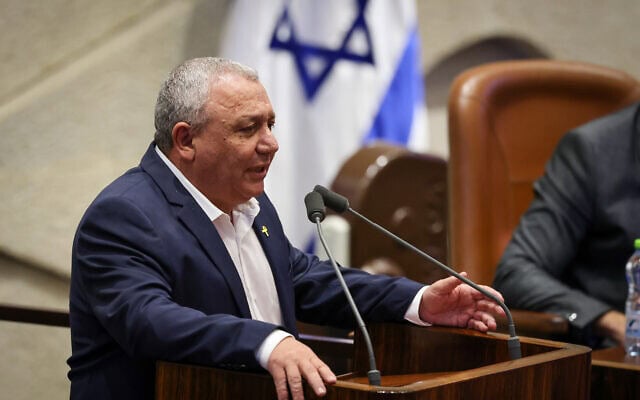
Gadi Eisenkot speaks at a podium inside Israel’s Knesset during an earlier parliamentary debate. Archive photograph, not from the November 2026 swearing-in.
On this page
A new parliament, an old political battle
Israel’s newly elected parliament has begun its work amid an intense struggle over the country’s political direction.
Gadi Eisenkot, the former military chief now tasked with forming a government, has promised to reverse several major policies introduced under Benjamin Netanyahu.
The new Knesset was sworn in on November 10, following an October 27 election that left Netanyahu’s political bloc without a parliamentary majority.
Opposition prepares a legislative challenge
Eisenkot’s allies are moving ahead with proposals that could reshape Israel’s political institutions, even before a new government takes office.
Their proposed measures include establishing a state commission of inquiry into the security failures surrounding the Hamas-led October 7, 2023 attacks, introducing limits on how long a person can serve as prime minister, and reversing changes that weakened the judiciary.
The opposition has also begun efforts to replace Knesset Speaker Amir Ohana, a Netanyahu ally. It has nominated Matan Kahana, a member of Eisenkot’s Yashar party, for the position.
The speaker has considerable influence over which bills receive parliamentary attention. Replacing Ohana could therefore give the opposition a stronger hand during the political transition.
Netanyahu remains in power for now
Despite losing his parliamentary majority, Netanyahu remains caretaker prime minister while coalition negotiations continue.
His government retains authority over national security and the military, although certain powers are subject to legal restrictions.
Eisenkot has up to six weeks to assemble a governing coalition. If he fails, President Isaac Herzog may give Netanyahu another opportunity to form a government.
The possibility of another election remains if neither politician can secure enough support.
Disagreement over cooperation with Arab parties
One of the biggest obstacles facing Eisenkot is whether his coalition can rely on Arab-led parties.
Some opposition groups are open to cooperation, but the arrangement has drawn fierce criticism from Netanyahu, who has argued that Jewish-led parties should unite rather than depend on Arab political support.
Eisenkot has left the possibility open under certain conditions, including recognition of Israel as a Jewish state and opposition to Hamas.
He described Netanyahu’s recent remarks against potential cooperation as divisive. The disagreement exposes a difficult question for the opposition: whether removing Netanyahu from power is worth building a coalition across political and ideological lines.
The next six weeks could reshape Israeli politics
Israel is entering a consequential period. The opposition may be able to pass legislation before it succeeds in forming a government, while Netanyahu continues to exercise caretaker authority.
The proposed inquiry into the October 7 attacks could also reopen questions about the government’s handling of national security before the assault.
For now, Eisenkot faces two battles at once: assembling a governing majority and using the new parliament to challenge policies that have defined Netanyahu’s years in office.
Neither outcome is guaranteed.


